Octoparse Review 2026: Is This No-Code Web Scraping Tool Right for You?
Octoparse has become a popular option in the no-code web scraping space. With its visual, point-and-click interface and extensive template library, it promises to make data extraction accessible to anyone, regardless of technical background. For e-commerce businesses in particular, it's often considered for tasks like monitoring competitor prices and tracking product availability.
To create this Octoparse review, I've analyzed the platform extensively. I believe it's the ideal choice if:
-
You need a flexible tool for extracting data from various websites
-
You're comfortable building and maintaining your own scraping workflows
-
You want to handle data processing and analysis yourself
-
You have diverse scraping needs beyond just price monitoring
-
You prefer a DIY approach with full control over your data collection
However, Octoparse might not be the best approach if:
-
You specifically need e-commerce competitive price intelligence
-
You want automatic product matching across competitor websites
-
You need built-in analytics and pricing recommendations
-
You prefer a turnkey solution over building your own scrapers
-
You don't want to maintain scrapers when websites change structure
In this case, you should consider GetRealPrice: a specialized B2B price intelligence platform that takes a fundamentally different approach. Rather than requiring you to build and maintain scrapers, GetRealPrice handles the entire data collection infrastructure with a team of 36 IT specialists maintaining custom parsers. The platform automatically matches your products across competitor websites, without requiring EAN codes or standardized identifiers, tracks prices daily, and delivers ready-to-use analytics with rule-based pricing recommendations that pricing strategists can actually understand and explain.
If you're specifically looking for e-commerce competitive intelligence without the DIY complexity, you can explore GetRealPrice's free trial here.
Table of contents:
-
What is Octoparse?
-
Octoparse Pros & Cons
-
Octoparse Review: How it Works & Key Features
-
Where Octoparse Falls Short
-
A Different Approach to Competitive Price Intelligence: GetRealPrice
-
Octoparse or GetRealPrice: Comparison Summary
-
Final Verdict
What is Octoparse?
Octoparse is a cloud-based web scraping platform designed to extract data from websites and transform it into structured formats like CSV, Excel, and JSON.
The platform caters specifically to users without programming knowledge, offering a visual interface where users can point and click on web elements to define what data they want to collect.
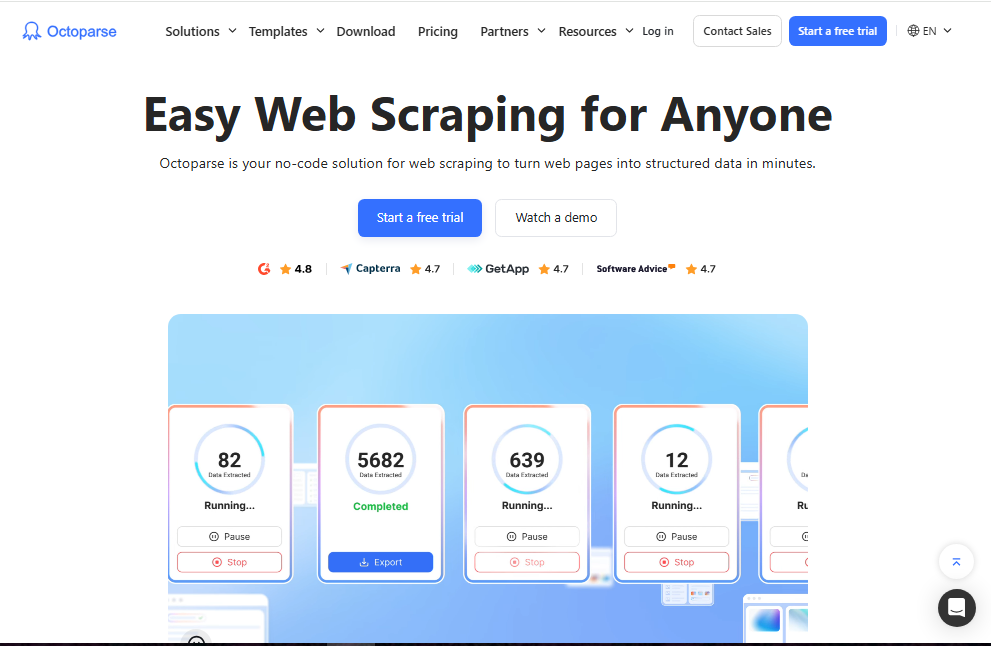
The software simulates human browsing behavior to navigate websites, including opening pages, logging into accounts, clicking elements, and handling dynamic content loaded via JavaScript and AJAX. It can run scraping tasks either locally on the user's computer or on Octoparse's cloud platform, which enables 24/7 data collection and scheduling.
Octoparse provides hundreds of pre-built templates for popular websites like Amazon, Google Maps, and LinkedIn, allowing users to start extracting data with minimal configuration. For more complex scenarios, users can build custom workflows using the visual editor, with support for features like pagination handling, infinite scrolling, and CAPTCHA solving.
The platform is marketed toward a wide range of use cases, including marketers conducting competitive research, data analysts gathering datasets, e-commerce businesses monitoring prices, recruiters scraping job boards, and researchers collecting information for academic projects.
Octoparse Pros & Cons
|
Pros |
Cons |
|---|---|
|
✅ No-code visual interface accessible to non-programmers |
❌ Learning curve for complex scraping scenarios |
|
✅ Handles dynamic websites with JavaScript and AJAX |
❌ Scrapers require maintenance when websites change |
|
✅ Cloud extraction runs 24/7 without your computer |
❌ Advanced data analysis requires external tools |
|
✅ Hundreds of pre-built templates for popular websites |
❌ No apparent built-in product matching for e-commerce |
|
✅ AI-powered auto-detection of page elements |
❌ No automated pricing recommendations |
|
✅ Flexible export to CSV, Excel, JSON, and databases |
Octoparse Review: How it Works & Key Features
Visual Workflow Designer: The core interface for building scrapers without code.
The Workflow Designer is where users create their scraping tasks through a visual, point-and-click interface.
When you enter a URL, Octoparse loads the webpage in its built-in browser, allowing you to click directly on the elements you want to extract. Each action, whether opening a page, clicking an element, or extracting data, appears as a step in a visual flowchart.
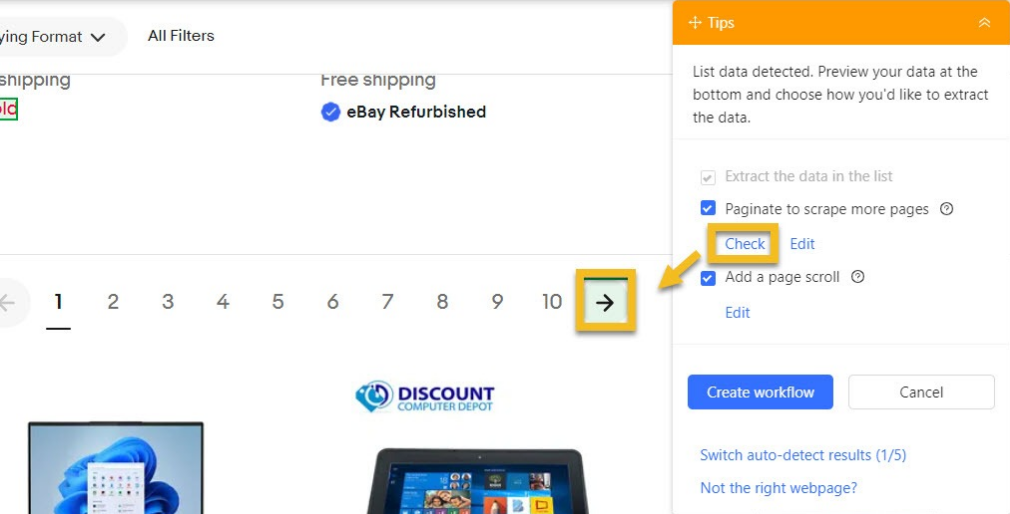
The platform includes an AI-powered auto-detection feature that scans web pages to automatically identify lists, tables, and pagination elements. For a product listing page, it can detect product names, prices, and images, though users may need to review and refine these suggestions for optimal results.
Source: Octoparse
For more precise control, Octoparse supports XPath and Regular Expressions. XPath allows targeting specific HTML elements even when they're difficult to select visually, while RegEx helps clean and format extracted data. The workflow can handle pagination by clicking "Next" buttons, scrolling through infinite-scroll pages, or iterating through dropdown menus.
Cloud Extraction: Run scraping tasks around the clock on remote servers.
Cloud Extraction allows users to run their scraping tasks on Octoparse's servers rather than their local machines. Once a task is deployed to the cloud, it operates independently of the user's computer, running 24/7 even when the computer is turned off.
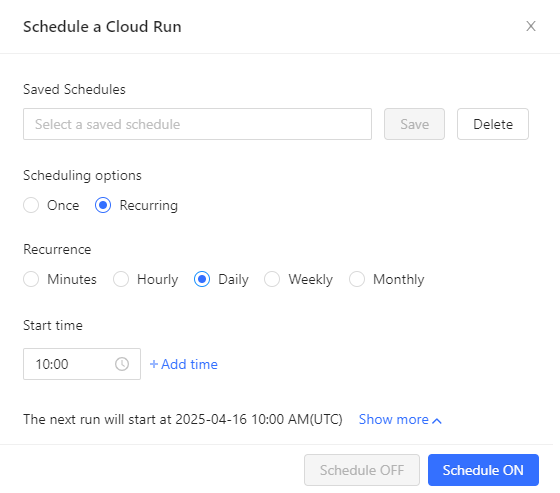
The cloud platform offers several advantages over local extraction. Tasks can be scheduled to run at specific intervals, from hourly to monthly, enabling automatic data updates without manual intervention. The system supports parallel processing, splitting large tasks across multiple servers to complete them faster. Octoparse claims cloud extraction can be 6 to 20 times faster than local runs.
Source: Octoparse
Automatic IP rotation is built into the cloud service. Requests are distributed across a pool of IP addresses, reducing the likelihood of being blocked by target websites. Data scraped in the cloud is stored on Octoparse's servers and can be accessed and exported from anywhere.
Pre-Built Templates: Ready-to-use scrapers for popular websites.
Octoparse provides hundreds of pre-built templates covering e-commerce platforms, social media networks, search engines, job boards, and real estate sites. These templates are pre-configured scrapers that require only minimal input, typically a URL or keyword, to start extracting data.
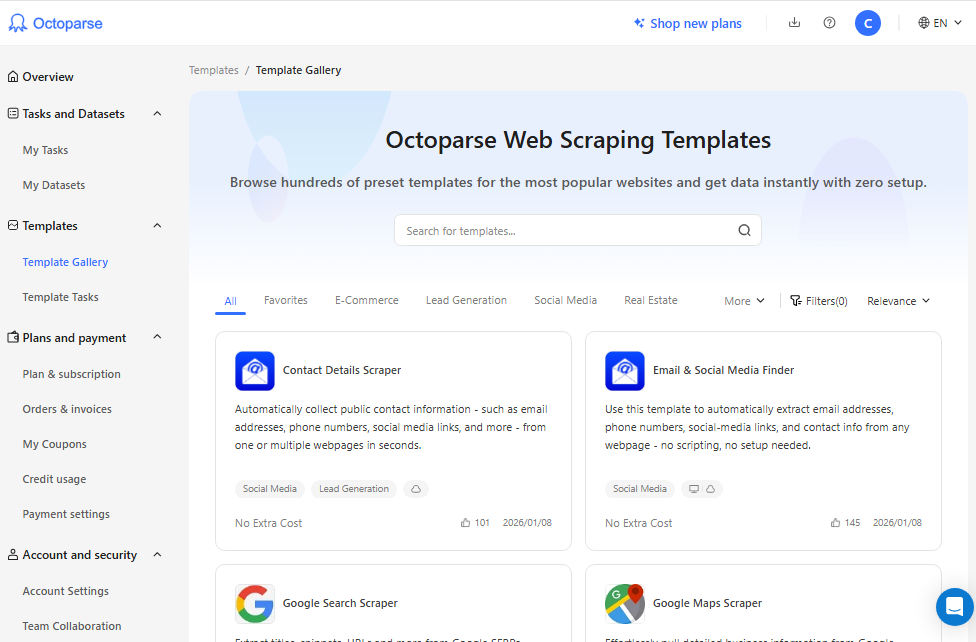
For Amazon, templates can extract product details, prices, reviews, and seller information. Google Maps templates pull business listings with addresses, phone numbers, and ratings. Social media templates handle platforms like Twitter and YouTube for posts, comments, and profile data.
Templates eliminate the need to build scrapers from scratch for common websites. Users select a template, enter their parameters, and run the extraction. The templates are maintained by Octoparse to account for website changes.
Data Export and Integration: Getting your data out of Octoparse.
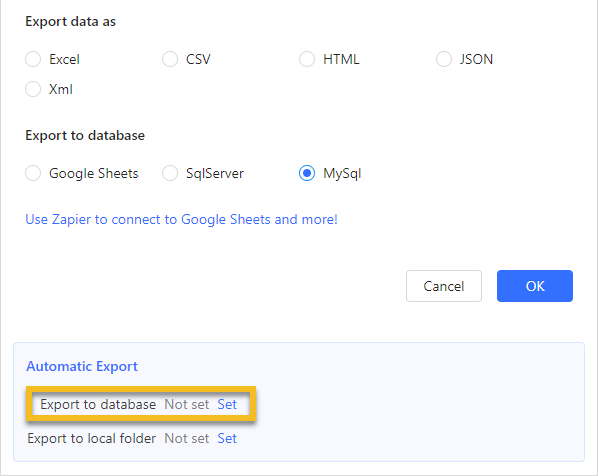
Octoparse supports exporting scraped data in multiple formats: CSV, Excel (.xlsx), HTML, and JSON. Users can export manually after a task completes or configure automatic exports that trigger when new data is collected.
Source: Octoparse
For database integration, the platform connects directly to MySQL, SQL Server, PostgreSQL, and Oracle. Users provide connection credentials, map scraped fields to database columns, and can set up automated exports at scheduled intervals.
Cloud storage integration includes Google Drive, Dropbox, and Amazon S3, available in Professional and Enterprise plans. Google Sheets export is also supported. API access allows programmatic retrieval of data and, in higher tiers, control over tasks including starting, stopping, and updating parameters.
Where Octoparse Falls Short
While Octoparse excels as a general-purpose web scraping tool, several limitations become apparent for users with specific use cases like e-commerce competitive intelligence. These limitations reflect the platform's optimization for flexibility rather than specialized applications.
Product Matching is Manual: When monitoring competitor prices, one of the biggest challenges is identifying the same product across different websites.
Product titles, descriptions, and images vary between retailers. Octoparse extracts whatever data you configure it to collect, but identifying that "Product A" on one site matches "Product A" on another site is entirely up to you. There's no apparent built-in intelligence for product matching, which means additional processing after extraction.
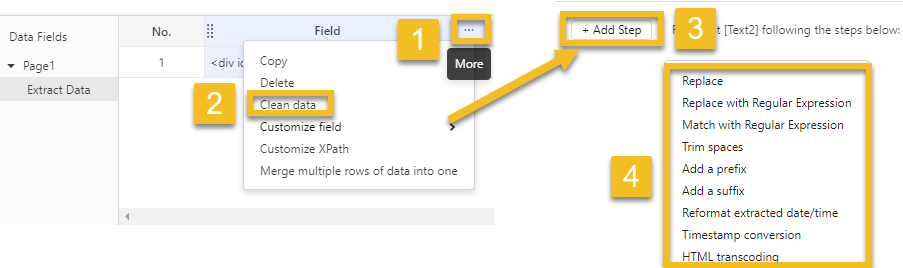
Data Analysis Requires External Tools: Octoparse delivers data in your chosen format and includes basic data-cleaning functions within the platform.
However, as Octoparse's own documentation notes, it is primarily a web scraping tool, and advanced analysis, visualization, and deriving insights requires separate tools and processes. For price monitoring, this means building your own systems to track price changes over time, compare your prices against competitors, and identify trends.
Source: Octoparse
Scraper Maintenance is Ongoing: Websites frequently change their structure, and when they do, scrapers break.
A product page that worked last week might fail today because the site updated its layout. While templates are maintained by Octoparse, custom scrapers require user attention. For businesses relying on consistent daily price data, unexpected scraper failures create gaps.
No Pricing Recommendations: Octoparse collects data but doesn't act on it. For e-commerce businesses, the goal of price monitoring is often to inform pricing decisions. Octoparse provides no automated pricing rules, no margin calculations, and no recommendations for how to price products based on competitive data.
These limitations aren't failures; they're the natural result of building a flexible, general-purpose tool. Octoparse lets you scrape almost anything, but transforming that capability into actionable e-commerce intelligence requires substantial additional work. For teams whose primary need is competitive pricing intelligence, a specialized approach may prove more efficient.
A Different Approach to Competitive Price Intelligence: GetRealPrice
GetRealPrice takes a fundamentally different approach to competitive price monitoring. Rather than providing tools to build your own scrapers, it delivers a managed B2B platform specifically designed for e-commerce businesses.
Established in 2014 in Latvia and now operating with offices across USA, Europe and MENA, the platform has spent over a decade serving retailers, marketplaces, and FMCG manufacturers who need reliable competitive intelligence without the operational complexity of maintaining their own data collection infrastructure.
Product Matching Without EAN Codes: Automatic identification of your products across competitors.
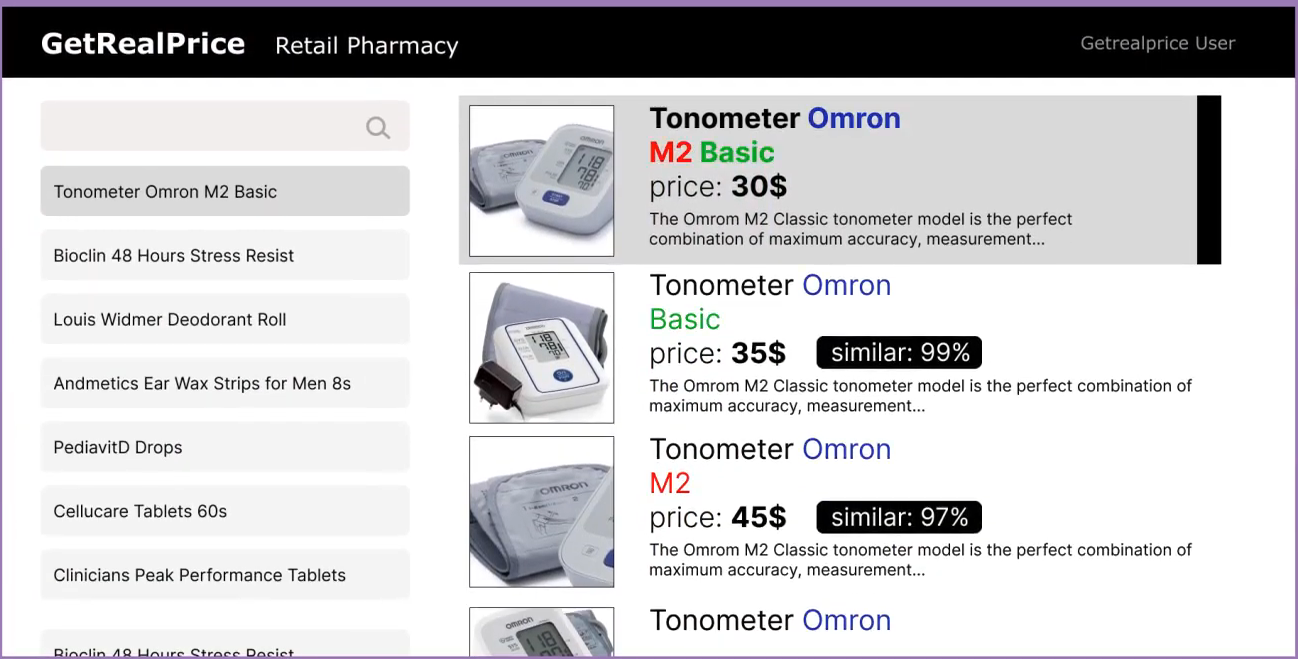
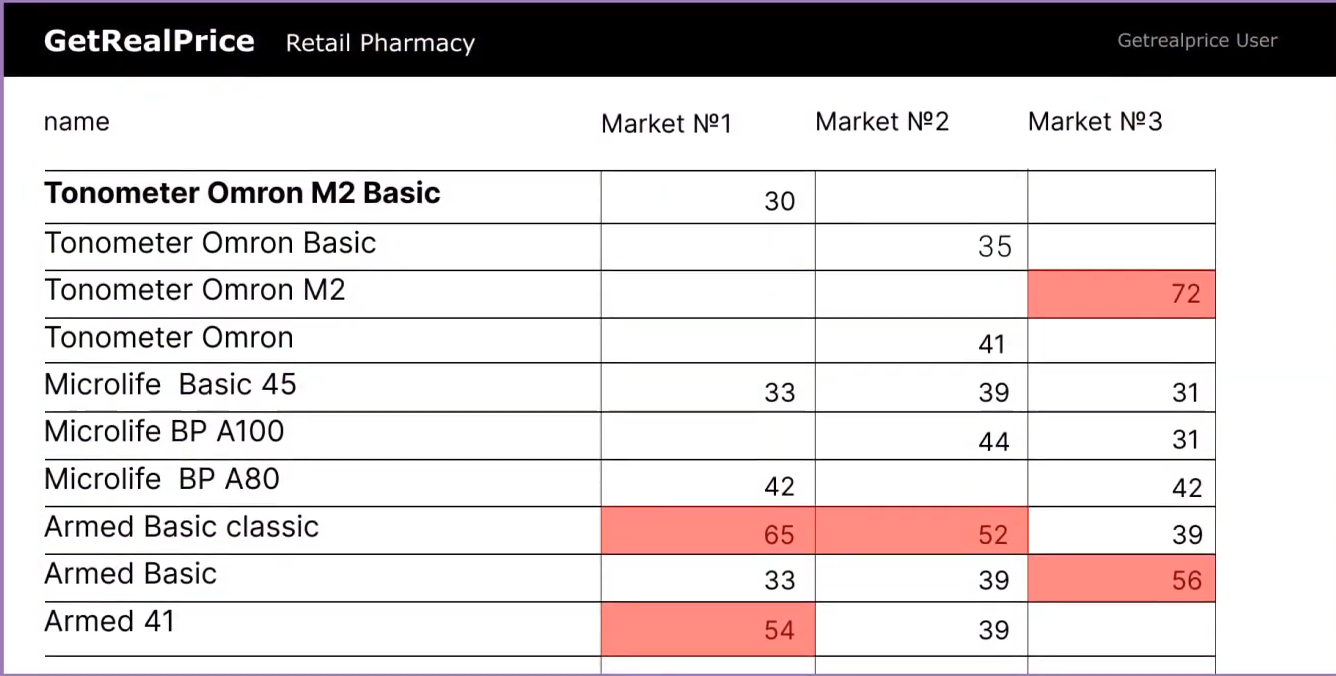
The foundation of GetRealPrice is its product matching technology. Unlike approaches that require standardized product identifiers, GetRealPrice performs direct product matching using only product names as input.
The platform's matching engine analyzes product attributes, including images using ResNet neural networks, descriptions, titles, and specifications, to find matching products on competitor websites, even when naming conventions vary significantly between retailers.
Source: GetRealPrice
The system handles two types of matching. "Duplicate" matching identifies identical SKUs across different stores. "Analog" matching finds similar products from different brands that share the same functional specifications.
For example, the platform can match a "Hexagon head bolt DIN933 M6x55 stainless steel A2" from one supplier with differently-named equivalents from other suppliers, recognizing they're the same product based on parameters like "933, A2, 6x55, steel" despite completely different product names. This capability extends across categories including DIY products, tools, pharmaceuticals, and FMCG goods.
Source: GetRealPrice
To ensure quality, AI matches undergo two levels of human verification before being finalized. This combination of automation with human oversight reflects GetRealPrice's philosophy of using AI where it adds value, specifically for pattern recognition in matching, while maintaining the accuracy that enterprise clients require.
The platform also handles package size normalization automatically. When your products come in different quantities than competitor offerings, GetRealPrice applies price multiplicators to enable direct comparisons. If you sell 750 vitamin pills and a competitor sells 800, the system recalculates prices to normalize the comparison without manual intervention.
Competitor Monitoring: Daily tracking of prices, stock, and promotions.
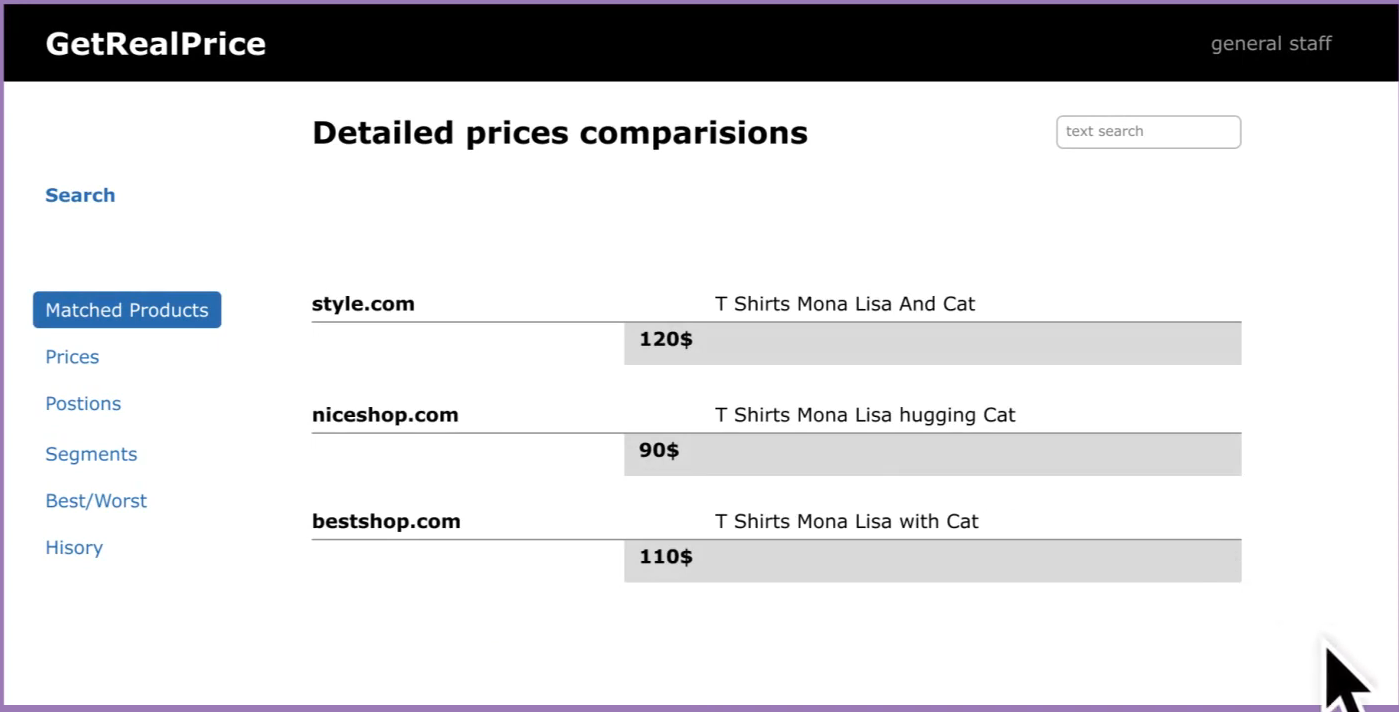
GetRealPrice monitors matched products on competitor websites daily, tracking current prices, price history over time, stock availability (where displayed), and active promotions. The platform covers competitors globally, operating in any country and currency.
Source: GetRealPrice
What differentiates the monitoring capability is the underlying infrastructure. GetRealPrice maintains a team of 36 IT specialists who write and maintain custom parsers for each data source.
Unlike tools limited to easily-scraped platforms, GetRealPrice crawls data from all available sources, including standard websites, mobile applications, and websites with anti-crawling defenses. When a website changes its structure and breaks a crawler, GetRealPrice typically restores data collection within 4 hours, ensuring the consistent daily data delivery that enterprise clients require.
The platform presents monitoring data through a unified dashboard showing where your prices are higher or lower than competitors. Users can drill into specific products, view historical trends, and understand their competitive position at a glance.
An alert system notifies users via email when significant changes occur, such as a competitor dropping prices on key products or items going out of stock, and the team proactively notifies clients about unusual price deviations or opportunities, even when not asked.
Rule-Based Repricing: Transparent pricing logic that strategists can explain.
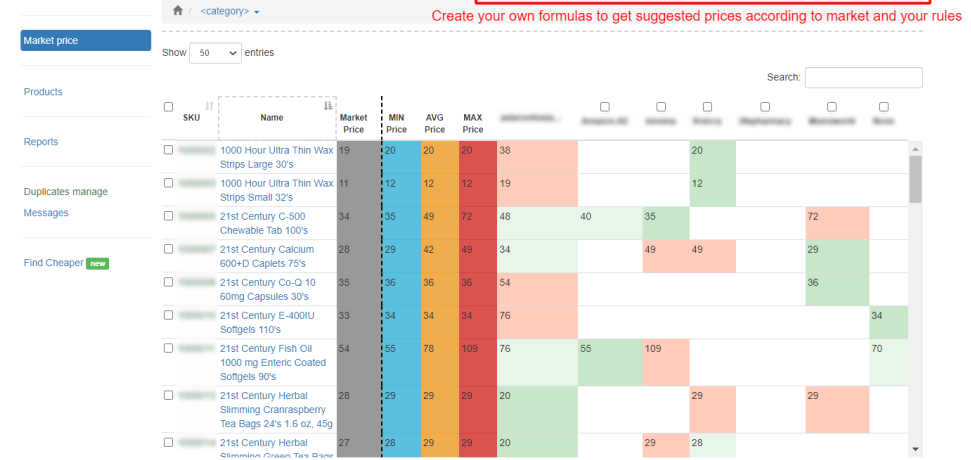
Beyond monitoring, GetRealPrice offers automated pricing capabilities, but with a deliberate difference in approach. The repricing system uses proven mathematical formulas rather than AI, maximizing price based on stock level, turnover, and competitor prices.
This distinction matters for pricing professionals. When AI determines prices, it generates logic that no one can fully explain; a "black box" that pricing strategists cannot justify to management or stakeholders.
GetRealPrice's formula-based approach ensures that every pricing recommendation can be traced back to clear inputs: if a competitor dropped their price, if stock levels changed, if turnover increased. Pricing analysts can always explain why a specific price was recommended, making the system trustworthy for enterprise decision-making.
Source: GetRealPrice
Users define business rules, such as "match the cheapest competitor's price as long as profit margin stays above 5% and competitors have stock available", and the system executes these rules automatically based on the latest competitive data. Through API integration, calculated prices can be pushed directly to a user's e-commerce platform, creating a closed loop from competitive intelligence to pricing action.
Reporting and Integration: Built-in intelligence from your competitive data.
GetRealPrice provides over 1,820 report templates covering various aspects of competitive intelligence. Users can generate reports on price positioning, market trends, competitor activities, and more. Reports can be customized by selecting specific data fields and scheduled for automatic delivery.
The dashboard includes graphical representations of data, allowing users to quickly understand their competitive position without exporting to separate analysis tools. Data can be exported in CSV, Excel, and JSON formats.
For more advanced integrations, the platform supports connections to Google Cloud storage, AWS, direct database connections, and API access for integration with internal systems like ERP platforms.
Octoparse or GetRealPrice: Comparison Summary
|
Aspect |
Octoparse |
GetRealPrice |
|---|---|---|
|
Primary Purpose |
General-purpose web scraping |
E-commerce price intelligence |
|
Approach |
DIY: build your own scrapers |
Managed B2B platform |
|
Setup Process |
Design workflows, configure extraction |
Connect product catalog |
|
Product Matching |
Manual (user responsibility) |
Automatic—no EAN codes required, includes analog matching |
|
Price Updates |
User schedules and runs scrapers |
Daily (handled by platform) |
|
Data Sources |
User-configured websites |
Any source including mobile apps, anti-crawling defended sites |
|
Analytics |
Export and analyze yourself |
Built-in (1,820+ reports) |
|
Pricing Recommendations |
Not included |
Rule-based repricing with explainable logic |
|
Maintenance |
User maintains scrapers |
36 IT specialists maintain parsers; 4-hour recovery |
|
Flexibility |
Scrape any website for any purpose |
E-commerce price intelligence focused |
|
Starting Price |
Free plan available; paid plans from $89/month |
Contact for pricing |
Final Verdict
The choice between Octoparse and GetRealPrice depends on what you're trying to accomplish and how you prefer to work.
Choose Octoparse if you need a flexible tool for extracting data from various websites and are comfortable with a DIY approach.
It's well-suited when your data needs extend beyond price monitoring to areas like lead generation, market research, content aggregation, or any scenario requiring custom scraping. The platform suits users who want full control over their data collection workflows and are willing to invest time in building and maintaining scrapers.
If you have technical resources available and varied scraping needs, Octoparse's flexibility becomes a significant advantage.
Choose GetRealPrice if your specific goal is e-commerce competitive intelligence and you need reliable daily operations without building and maintaining your own infrastructure.
The platform is designed for retailers, marketplaces, and manufacturers who need to monitor competitor prices, understand their market position, and make data-driven pricing decisions, with the confidence that comes from explainable, formula-based recommendations rather than AI black boxes.
GetRealPrice handles product matching (including across different brands and package sizes), data collection from any source, and analysis, delivering actionable insights rather than raw data. For teams where competitive pricing directly impacts business results and consistent data delivery is non-negotiable, this approach eliminates the operational burden of a DIY solution.
Both platforms serve their respective purposes well. Octoparse offers the flexibility to scrape almost anything, while GetRealPrice delivers focused, reliable price intelligence for e-commerce operations.
Your choice depends on whether you need a versatile tool or a specialized solution with proven daily operations.