Bright Data Review 2026: Is This Web Data Platform Right for You?
Bright Data has established itself as one of the most comprehensive web data platforms available, serving over 20,000 organizations with its massive proxy network and sophisticated data collection tools. With more than 150 million residential IPs spanning 195 countries, it provides the infrastructure that powers competitive intelligence operations for Fortune 500 companies and data-driven teams worldwide.
To create this Bright Data review, I've analyzed the platform extensively. I believe it's the ideal choice if:
-
You need flexible, large-scale data collection infrastructure
-
You have technical resources to build and maintain custom scraping solutions
-
Your data needs extend beyond price monitoring to multiple use cases
-
You want granular control over your data collection operations
-
You require enterprise-grade proxy networks with global coverage
However, Bright Data might not be the best approach if:
-
You specifically need e-commerce price monitoring without building infrastructure
-
You lack dedicated technical resources for scraping development
-
You want a turnkey solution that works immediately
-
Your primary goal is competitor price tracking rather than general data collection
-
You prefer predictable monthly costs over usage-based pricing
In this case, you should consider GetRealPrice: a dedicated price monitoring platform that takes a fundamentally different approach. Rather than providing infrastructure for you to build your own solution, GetRealPrice delivers a complete system with AI-powered product matching, automated competitor monitoring, and rule-based pricing recommendations, all without requiring any technical implementation on your end.
Because of that, I've included a detailed look at GetRealPrice later in this Bright Data review, as it represents a different approach for businesses specifically focused on e-commerce competitive intelligence. If you're ready to explore a specialized approach to price monitoring, you can start with GetRealPrice's free trial here.
Table of contents:
-
What is Bright Data?
-
Bright Data Pros & Cons
-
Bright Data Review: How it Works & Key Features
-
Where Bright Data Falls Short
-
A Different Approach to Price Monitoring: GetRealPrice
-
Bright Data or GetRealPrice: Comparison Summary
-
Final Verdict
What is Bright Data?
Bright Data was founded in 2014 as Luminati Networks, a division of the Hola VPN company, by Ofer Vilenski and Derry Shribman.
The company was an early leader in residential proxies when the industry was dominated by datacenter solutions. In March 2021, it rebranded to Bright Data to reflect its evolution from a proxy infrastructure provider to a comprehensive web data collection platform.
Today, Bright Data positions itself as the "world's #1 web data platform," offering a suite of services that includes proxy networks, AI-powered web scraping tools, dynamically refreshed datasets, and managed data acquisition services. The platform processes trillions of HTTPS requests annually.
The company serves a diverse range of customers, from startups testing market hypotheses to Fortune 500 enterprises running large-scale competitive intelligence operations.
Key use cases include e-commerce price monitoring, market research, ad verification, financial data gathering, and AI training data collection. Bright Data emphasizes its commitment to ethical IP sourcing, with residential IPs coming from users who have voluntarily opted into their network.
The ideal Bright Data customer is a technically sophisticated organization that needs flexible, large-scale data collection capabilities and has the resources to build custom solutions on top of the platform's infrastructure.
Bright Data Pros & Cons
|
Pros |
Cons |
|---|---|
|
✅ Massive proxy network with 150M+ residential IPs across 195 countries |
❌ Steep learning curve for beginners |
|
✅ Comprehensive suite of tools from proxies to complete datasets |
❌ Requires technical expertise for most effective use |
|
✅ 99.99% uptime guarantee for datacenter and mobile networks |
❌ Complex pricing across multiple products |
|
✅ Advanced unblocking capabilities with AI-powered CAPTCHA solving |
❌ Retail intelligence tools are part of a broader platform, not the primary focus |
|
✅ ISO 27001 certified with strong compliance focus |
❌ Can become expensive at scale |
|
✅ Extensive API support and integration options |
❌ Overwhelming feature set for simple use cases |
Bright Data Review: How it Works & Key Features
Proxy Network Infrastructure: The Foundation of Data Collection
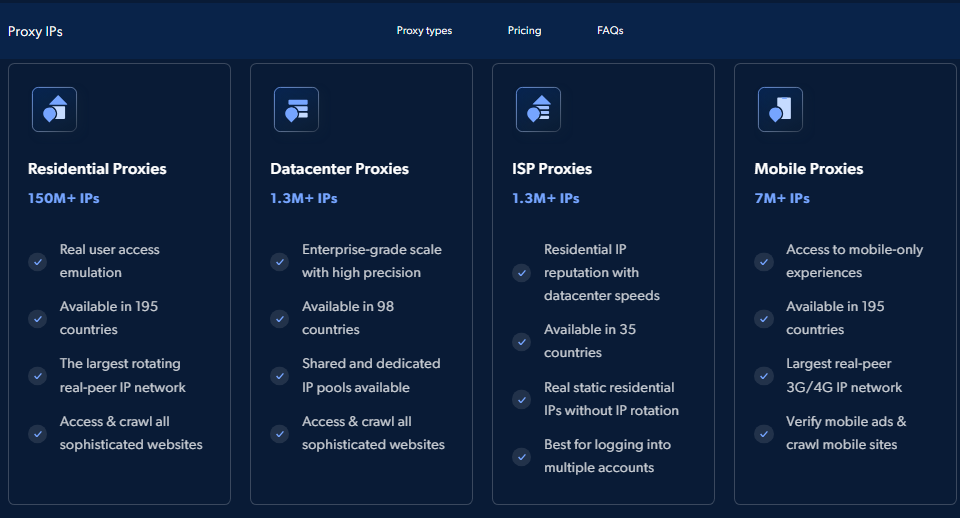
At the core of Bright Data's offering is its proxy network infrastructure, which provides access to over 150 million IPs across four main types.
Residential proxies come from real user devices, making them highly effective at bypassing advanced anti-bot measures. Datacenter proxies offer high speed and cost-effectiveness for less complex websites. ISP (static residential) proxies provide consistent IP addresses for tasks requiring stable sessions. Mobile proxies use IPs from real mobile devices connected to 3G/4G/5G networks.
Source: Bright Data
Users can target proxies with remarkable granularity, filtering by country, city, ZIP code, ASN, and even mobile carrier. The platform supports both rotating sessions (where IP addresses change with each request) and sticky sessions for maintaining the same IP over a period.
This flexibility allows businesses to configure their data collection operations precisely for their specific use cases.
The infrastructure supports unlimited concurrent sessions, enabling parallel data extraction at scale. A Proxy Manager application provides a graphical interface for managing proxy usage, setting custom routing rules, and monitoring performance in real-time.
Web Unlocker and Scraping Tools: Automated Access to Protected Sites
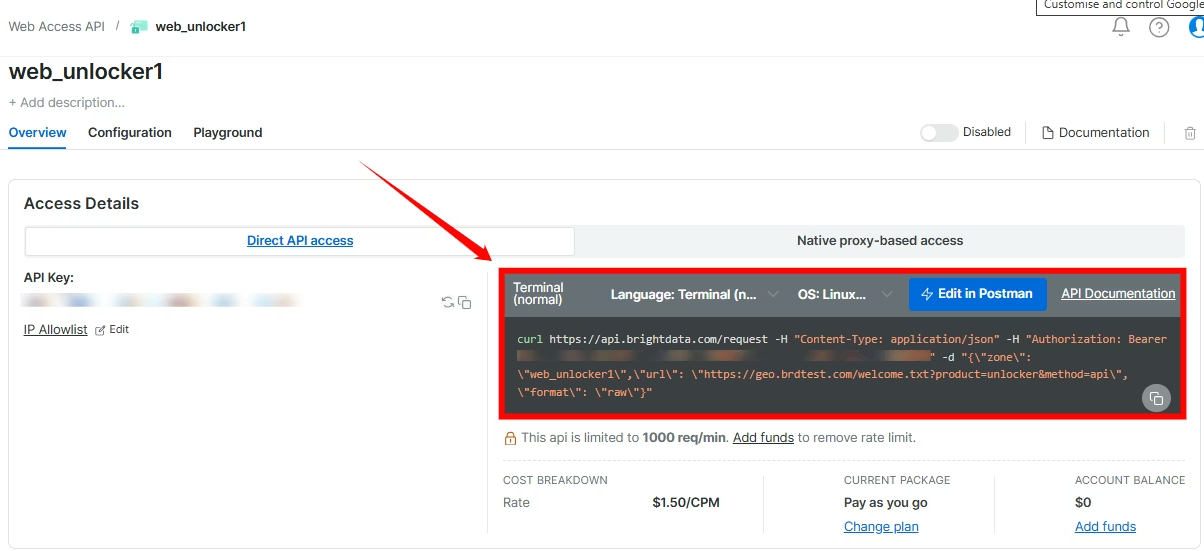
Bright Data's Web Unlocker is an AI-powered solution designed to overcome advanced website blocking mechanisms.
When a request is sent through the Web Unlocker, the system automatically handles proxy selection, CAPTCHA solving, browser fingerprint emulation, and automatic retries if requests fail. The service operates on a pay-per-successful-request model, meaning users only pay when data is successfully retrieved.
Source: Bright Data
The Scraping Browser provides cloud-hosted browser instances that can be controlled programmatically through Puppeteer, Playwright, or Selenium.
These "headful" browsers are less likely to be detected by anti-bot systems compared to standard headless browsers. Users can run unlimited simultaneous scraping browser sessions without managing their own browser infrastructure.
For developers who want more control, the Web Scraper IDE offers a cloud-based environment for building custom scrapers with JavaScript. It includes pre-built templates for popular websites, over 70 ready-made functions, and integrated debugging tools.
The serverless architecture means scrapers run on Bright Data's infrastructure, automatically scaling to handle any data volume.
Datasets and Data Collection: From Raw Data to Structured Information
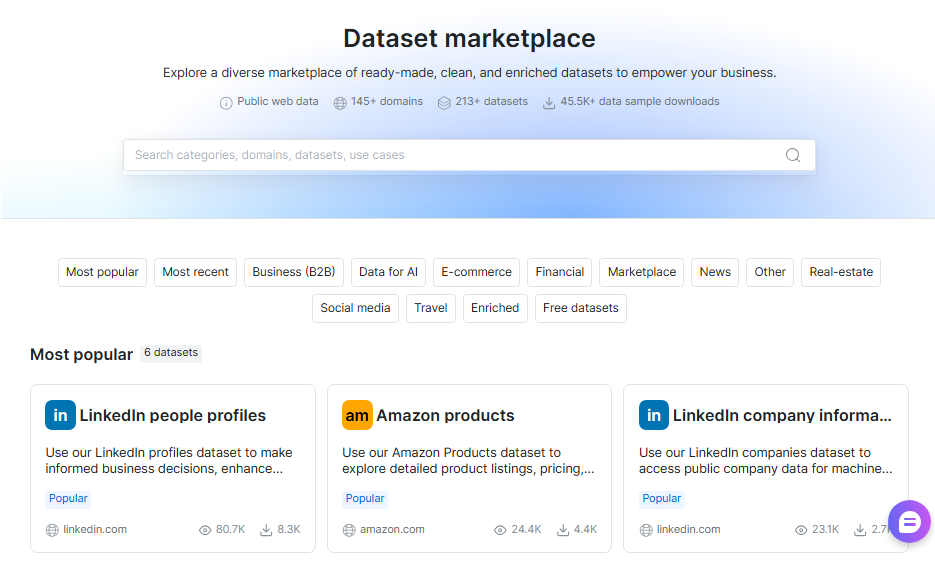
Beyond infrastructure, Bright Data offers pre-collected datasets through its Dataset Marketplace.
This includes over 190 datasets from more than 120 popular domains, covering e-commerce platforms like Amazon and Walmart, social media networks, business directories, and real estate websites. These datasets are cleaned, validated, and delivered in structured formats.
For specific data needs not covered by ready-made datasets, the Data Collector allows users to define custom data collection jobs. This can be done through a visual interface or by coding in the Web Scraper IDE. The SERP API specifically handles search engine results page data, delivering structured JSON from Google, Bing, DuckDuckGo, and other search engines.
Data can be delivered through multiple methods: API download, email, webhook, or direct delivery to cloud storage services like Amazon S3, Google Cloud Storage, and Microsoft Azure.
Pricing Structure: Usage-Based Model Across Products
Bright Data operates on a usage-based pricing model that varies by product.
Pricing scales with volume, so rates improve at higher usage tiers. At entry level, residential proxies start from $4 per GB (dropping to $2.50 per GB at high volumes). Datacenter proxies start from $1.40 per IP (dropping to $0.90 per IP at scale).
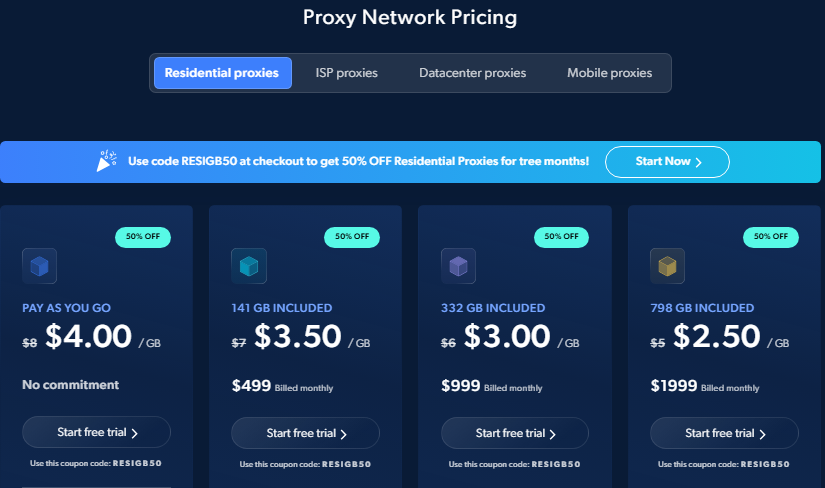
Source: Bright Data
The Web Unlocker, Crawl API, and SERP API start from $1.50 per 1,000 requests at entry level (dropping to $1 per 1,000 requests at high volumes). The Scraping Browser starts from $8 per GB (dropping to $5 per GB with commitment). Pre-collected datasets start from $250 per 100,000 records.
There's no permanent free plan, but a free trial is available. The modular pricing structure means total costs depend on which products are used and at what volume. For organizations needing multiple products, costs can add up quickly. Managed data acquisition services start from $1,500 per month for enterprises requiring fully handled data collection.
Where Bright Data Falls Short
While Bright Data excels as a comprehensive data collection infrastructure, several characteristics reveal a platform optimized for flexibility and technical users rather than specialized solutions for specific use cases.
Technical Expertise Required: The platform assumes users have the capability to build, deploy, and maintain their own data collection systems.
While the Web Scraper IDE provides templates and pre-built functions, effectively using Bright Data's core tools still requires JavaScript knowledge and understanding of web scraping concepts. Organizations without dedicated technical resources may find the learning curve significant.
Breadth Over Depth for Specific Use Cases: Bright Data does offer retail intelligence tools, including a Price Tracker and MAP Monitoring under its Bright Insights product line.
However, these exist within a much broader platform designed for general-purpose data collection. For businesses specifically seeking price monitoring, this means navigating a comprehensive platform where price monitoring is one use case among many, rather than the singular focus.
Maintenance Burden for Custom Solutions: If you choose to build custom data collection pipelines (which many Bright Data users do), you'll face ongoing maintenance responsibilities. When target websites change their structure, scrapers need updating. IP rotation strategies may need adjustment as anti-bot measures evolve. This operational overhead falls entirely on the user's team.
Pricing Complexity: The usage-based model across multiple products can make costs difficult to predict.
A comprehensive data collection operation might involve residential proxies, the Web Unlocker, and potentially the Scraping Browser, each with separate billing. For businesses seeking straightforward monthly budgeting, this complexity adds administrative overhead.
These characteristics aren't failures; they're the natural result of building a flexible infrastructure platform that serves thousands of different use cases. However, they create a clear opening for solutions that prioritize immediate time-to-value for specific use cases like e-commerce price monitoring.
A Different Approach to Price Monitoring: GetRealPrice
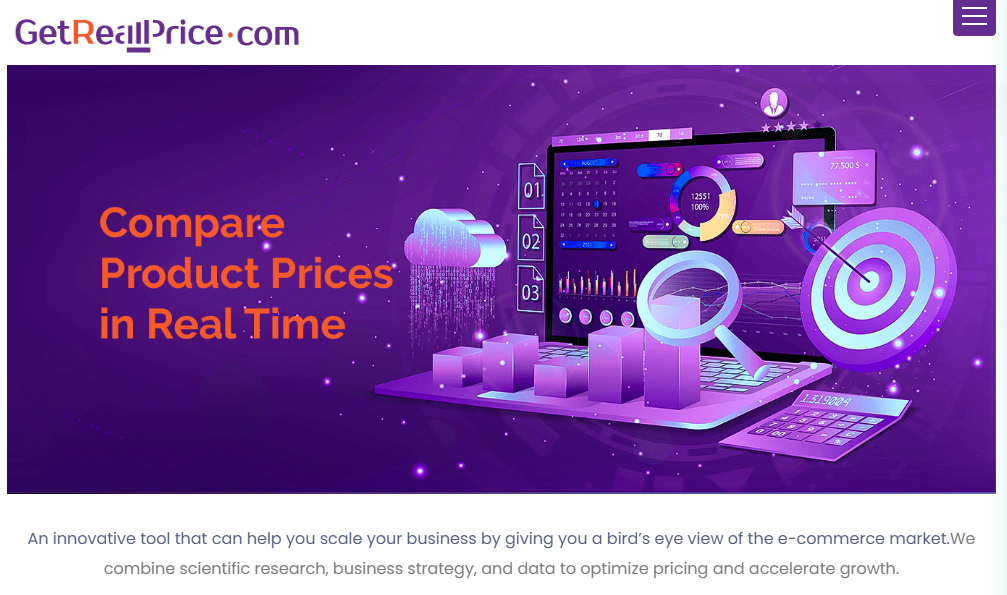
GetRealPrice takes a fundamentally different approach to competitive intelligence.
Rather than providing infrastructure for building custom solutions, it delivers a complete, purpose-built platform specifically designed for e-commerce price monitoring.
Founded in 2014, GetRealPrice has spent over a decade refining its approach, serving retailers, marketplaces, and FMCG manufacturers including enterprise clients like Decathlon, Castorama, and Nestle, who need reliable competitive pricing data without building data collection systems.
Complete Price Monitoring Solution: Designed for Reliability
GetRealPrice is designed to work upon setup.
Users provide their product catalog (via Excel file or e-commerce store connection), identify their competitors, and the system handles everything else, including the technical challenges that would require significant development effort on an infrastructure platform.
What distinguishes GetRealPrice is its ability to collect data from all sources, including standard websites, mobile applications, and sites with anti-crawling defenses.
The platform handles CAPTCHA solving, implements behavior patterns that mimic human shopping, and maintains custom parsers for each data source. When a target website changes its structure and breaks data collection, the team typically restores operations within hours, a reliability factor that matters for enterprise clients with strict operational requirements.
The platform can monitor competitors in any country and currency, tracking not just prices but also stock availability and promotional activities. All data flows into a unified dashboard that presents price monitoring, comparisons, price history, and stock information in a consolidated format.
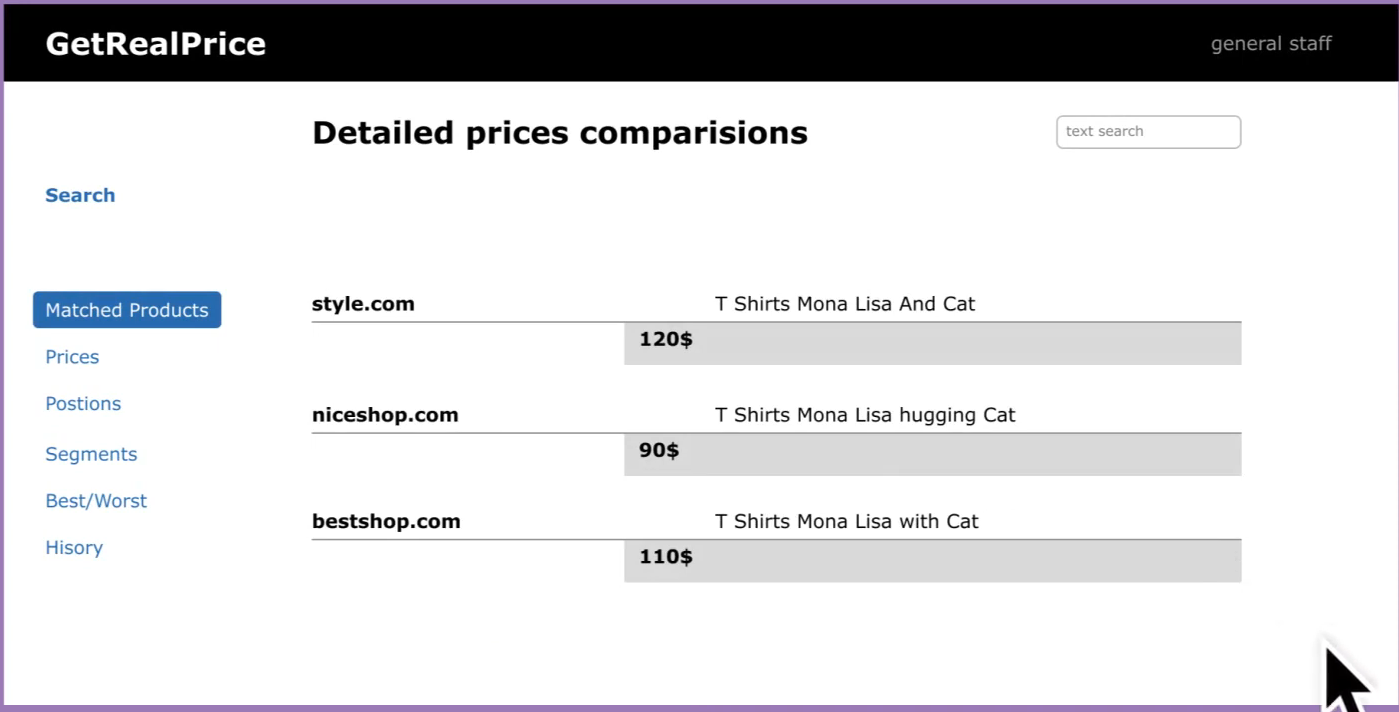
Source: GetRealPrice
The service is specifically adapted for large product catalogs, capable of handling 5 to 30 million SKUs. This scale, combined with the managed delivery model, means businesses can begin collecting competitive intelligence quickly without the extended development time required to build a comparable system from scratch.
AI-Powered Product Matching: The Critical Foundation
Product matching is where GetRealPrice's specialization becomes most apparent.
The platform uses AI algorithms combined with multi-layer human verification to match products across different online stores. This hybrid approach, AI for initial matching, followed by trained experts who verify results, achieves high accuracy while maintaining the transparency that pricing professionals require.
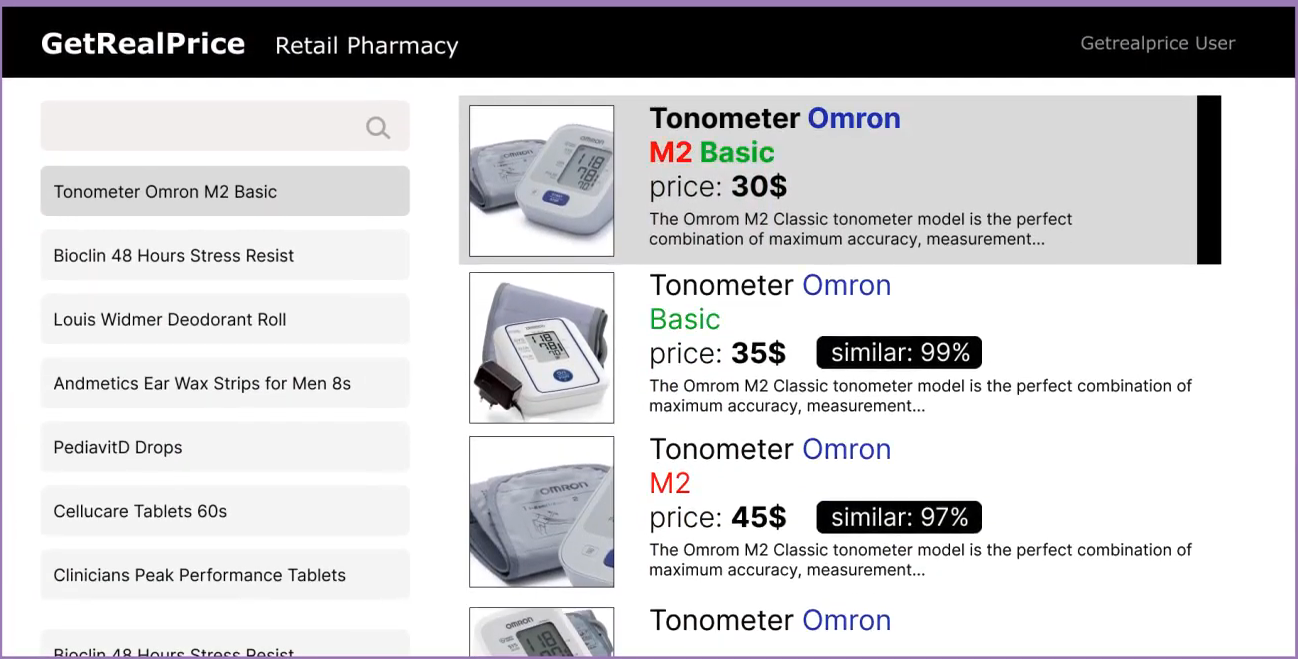
Source: GetRealPrice
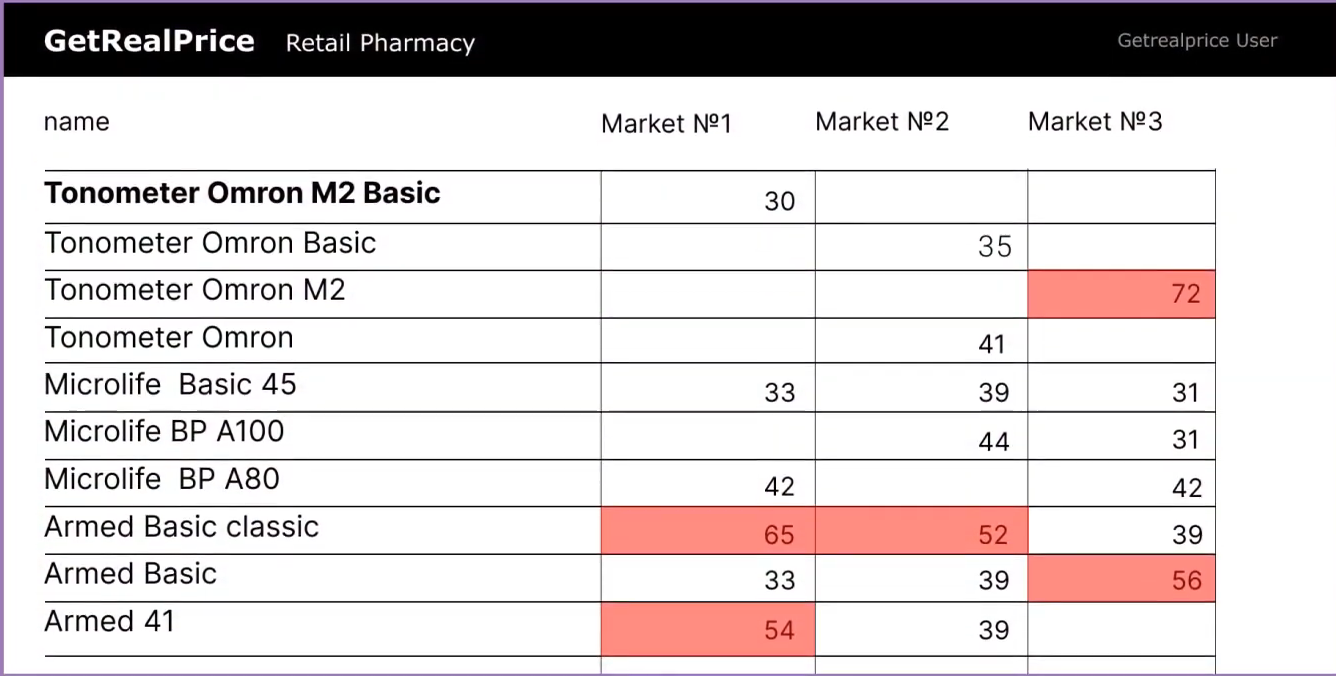
The system performs two types of matching.
First, it identifies products that are 100% identical (the same SKU across different sellers). Second, it identifies similar products from competing brands that share the same functional specifications, for example, matching equivalent industrial components from different manufacturers even when product names vary significantly between catalogs.
This capability extends to detecting rebranded products and normalizing package sizes when products come in different quantities, enabling apples-to-apples price comparisons.
Source: GetRealPrice
This combination of automated matching and human verification represents substantial value. Building equivalent matching logic from scratch would require significant machine learning expertise, quality assurance processes, and ongoing training as new products and variations appear in the market.
Rule-Based Pricing: Explainable Recommendations
Beyond data collection, GetRealPrice includes tools for acting on competitive intelligence through its automated pricing feature.
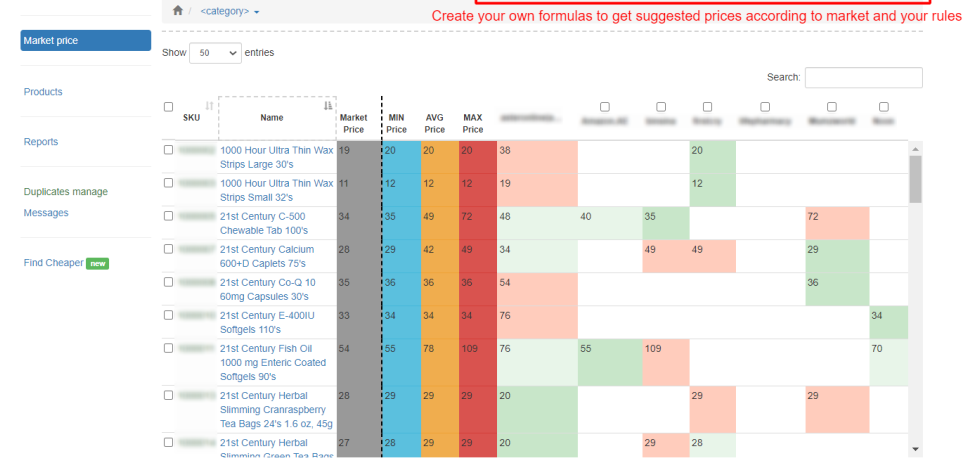
Notably, the system uses proven mathematical formulas rather than AI for price optimization. The repricing engine analyzes competitor prices and availability daily, then executes the business rules users have defined.
For example, a rule might be: "Match the cheapest competitor's price as long as the profit margin stays above 5% and the competitor has the item in stock." This rule-based approach means pricing strategists can always explain exactly why a specific price was recommended, a transparency that AI-driven pricing models often cannot provide.
Source: GetRealPrice
The competitor monitoring system provides a comprehensive view of rival activities, including price changes, stock availability, and promotional campaigns. Users can configure customized alerts to receive email notifications when specific conditions are met.
For FMCG manufacturers, the platform includes features to help monitor reseller compliance with recommended retail prices, helping identify when distribution partners may be deviating from pricing agreements.
Reporting, Support, and Enterprise Operations
GetRealPrice offers over 1,820 different report types, with extensive customization options. Users can define which data fields to include, set report delivery frequency, and receive reports via email or export them in CSV, XLSX, or JSON formats.
An API is available for integrating GetRealPrice data directly with internal systems like ERPs and databases. This enables automated price updates on e-commerce platforms based on the competitive intelligence gathered by the system.
Support is handled by experienced humans communicating with pricing professionals at client companies, not chatbots or automated responses. This approach reflects the reality that pricing intelligence is a specialized field where context and expertise matter.
Pricing starts at €1,050 per month for the Starter package, which includes monitoring of up to 3 competitor webshops, price matching for up to 10,000 SKUs per competitor, and access to approximately 100 report templates. A free trial provides access to premium features for evaluation.
Bright Data or GetRealPrice: Comparison Summary
|
Aspect |
Bright Data |
GetRealPrice |
|---|---|---|
|
Primary Approach |
Comprehensive data collection platform |
Dedicated price monitoring solution |
|
Target User |
Technical teams with diverse data needs |
E-commerce businesses needing price intelligence |
|
Setup Time |
Variable (depends on use case and approach) |
Designed for quick implementation |
|
Technical Requirements |
Higher for core infrastructure tools |
Lower (managed solution) |
|
Data Source Coverage |
Build-your-own for any source |
Any source including mobile apps, handled for you |
|
Product Matching |
Available via Retail Intelligence tools |
Core feature with AI + human verification |
|
Price Optimization |
Available via Retail Intelligence tools |
Built-in with rule-based repricing |
|
Support Model |
Documentation + enterprise support options |
Dedicated human experts |
|
Pricing Model |
Usage-based across multiple products |
Fixed monthly subscription |
|
Flexibility |
⭐⭐⭐⭐⭐ Maximum flexibility for any data |
⭐⭐⭐ Focused on price monitoring |
|
Specialization |
⭐⭐⭐ Broad platform with retail tools |
⭐⭐⭐⭐⭐ Purpose-built for price monitoring |
|
Scalability |
⭐⭐⭐⭐⭐ Enterprise-grade infrastructure |
⭐⭐⭐⭐ Handles 5-30M SKUs |
|
Best For |
Custom data solutions at scale |
Enterprise e-commerce price intelligence |
Final Verdict
The choice between Bright Data and GetRealPrice comes down to a fundamental question: do you need a flexible, comprehensive data platform, or do you need a specialized price monitoring solution with reliable, problem-free operations?
👉 Choose Bright Data if you're building an advanced data operation that extends beyond price monitoring.
It's the right choice when you have technical resources to leverage its infrastructure, need data for multiple use cases (market research, ad verification, AI training), or require the granular control that a comprehensive platform provides.
Organizations with dedicated engineering teams who want maximum flexibility will find Bright Data's capabilities invaluable. While Bright Data does offer retail intelligence tools for price monitoring, its greatest strength lies in its versatile infrastructure.
Get started with Bright Data here.
👉 Choose GetRealPrice if your primary goal is e-commerce competitive intelligence and you want a platform built specifically for that purpose with over a decade of refinement.
It's designed for businesses that need to monitor competitor pricing, track promotions, and optimize their own pricing strategy through a dedicated solution backed by human expertise. The managed approach means you're gathering competitive intelligence quickly, with technical complexity handled for you.
Every feature in the platform, from AI-powered product matching to rule-based repricing, is designed around price monitoring rather than being one module among many.
Get started with GetRealPrice here.
Both platforms serve their purposes well. Bright Data empowers technical teams to build whatever data solution they can imagine across countless use cases. GetRealPrice delivers a specialized solution for businesses that prioritize reliable data and want to use competitive intelligence rather than build the systems to gather it.
The right choice depends not on which platform is "better," but on which approach matches your resources, timeline, and operational requirements.